

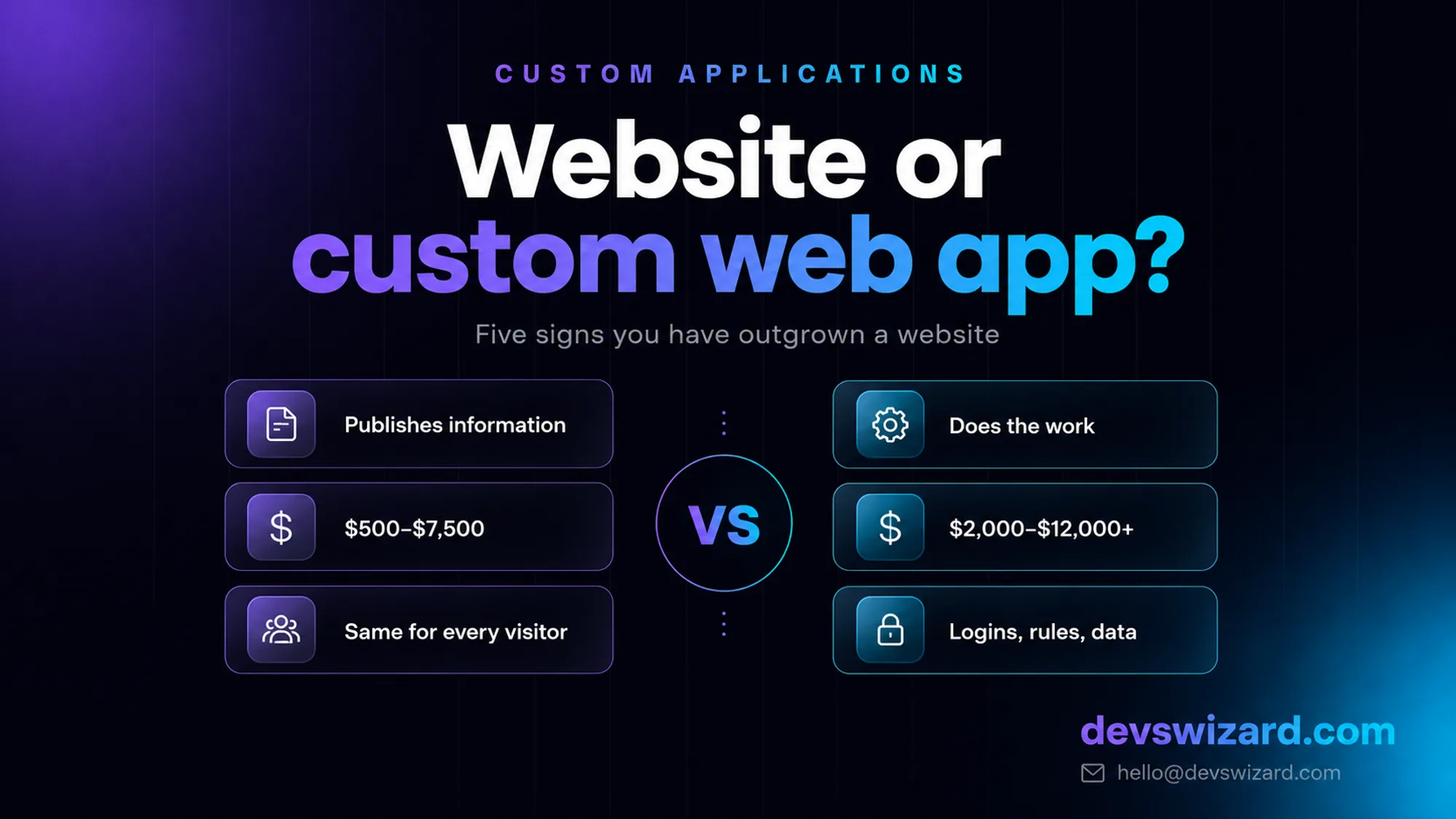
The website is fine. It explains what you do, it ranks for a few things, the contact form works. Meanwhile the actual business runs somewhere else entirely — a shared spreadsheet, a WhatsApp group, three subscriptions that half-fit, and one person who knows how it all connects.
At some point somebody says "we need an app". Usually they do not. They need one specific thing the website was never built to do, and the honest question is whether that thing is worth $2,000 or $20,000.
Here is how to tell the difference, what each actually costs, and the middle option most people end up taking.
A website publishes. It shows roughly the same thing to everyone who visits, and its job is to be found, be read, and get someone to make contact.
That covers more businesses than people expect. If your site's job is to make the phone ring, a website is the right build and anything more is a way to spend money slowly.
An application does work. It stores your data, enforces your rules, knows who is logged in, and shows different things to different people.
Same technology as a website in places, completely different job. That is why the price is different too.
The business runs on a spreadsheet several people edit. It works until two people open it at once, someone sorts one column without the others, or the formula nobody understands breaks. A spreadsheet is a brilliant prototype and a terrible system of record.
You pay for three tools that each half-fit. $40 here, $79 there, $120 for the one nobody likes. Two years of that is a custom build, and none of them will ever quite match how you work.
Somebody re-types the same data between systems. Order comes in on one platform, gets copied into a sheet, gets copied again into accounting. If that is an hour a day, it is roughly 250 hours a year — and every copy is a chance to get a number wrong.
Important rules live in one person's head. Who approves a discount, which customer gets which price, what happens when stock runs out. When that person is on holiday, the business slows down. Software makes the rule explicit and repeatable.
Your customers need to log in and see their own thing. Order status, past invoices, their booking, their documents. The moment a visitor needs an account, you have left website territory and entered custom application territory.
One of these is not a reason to build. Three of them together usually is.
We talk people out of custom builds regularly, because the cheaper option genuinely wins more often than agencies admit.
You mostly need to be found and contacted. A marketing site does that better and cheaper than anything custom.
You sell products. That is a store, not an app — WooCommerce or Shopify already handle catalogue, checkout, tax and shipping. Which one is its own decision, and neither is worth rebuilding from scratch.
An off-the-shelf tool exists and fits. Bookings, invoicing, CRM, help desk, project management — these are solved. Paying $50 a month beats owning code, right up until the tool forces you to change how you work.
You are still testing the idea. Prove the demand with something manual and ugly first. Automating a process nobody wants is the most expensive kind of software.
| Website | Custom web app | |
|---|---|---|
| What it does | Publishes information | Stores data and enforces rules |
| Who it serves | Everyone, the same way | Different users, different views |
| Typical cost | $500–$7,500 | $2,000–$12,000+ |
| Typical timeline | 2–6 weeks | 4 weeks to 4 months |
| Editing | You, through a CMS | You, through the admin we build |
| What breaks | Layout, plugins, speed | Logic, data, integrations |
| Ongoing cost | Hosting and maintenance | Hosting, maintenance, changes as you grow |
| When it fails you | The work happens elsewhere | You built something an existing tool did |
A brochure or marketing site is $500–$2,000 and takes two to three weeks. A bigger site with custom features, integrations or multiple languages is $2,000–$7,500 over four to six weeks.
On the application side, a focused tool that does one job well — a booking system, an internal dashboard, the thing replacing that spreadsheet — is $2,000–$7,000 and takes four to eight weeks. A full system with roles, integrations and reporting is $7,000–$12,000 across two to four months. Multi-tenant platforms and anything you intend to sell to your own customers start at $12,000.
The bottleneck is rarely the code. It is decisions. Every time we ask "what should happen if the customer cancels after paying?" and the answer takes a week to come back, the project takes a week longer. Businesses that have their rules written down before we start finish noticeably faster.
You rarely have to replace the website to get the software. The common answer is a normal site with one custom piece bolted on properly.
A car care brand in Saudi Arabia came to us wanting to sell gift cards. Nothing off the shelf covered it: the flow had to work in Arabic right-to-left, the gift had to arrive by WhatsApp or SMS rather than email, and branch staff needed to redeem codes in person without double-spending them. We built exactly that as a custom plugin on their existing WooCommerce store, so payments through their local gateways kept working untouched — two weeks, start to finish.
That is the shape to aim for. Keep the site doing what it is good at, and build only the part nobody sells.
If the work happens in conversations and the site's job is to start them → a website. Spend the difference on content and search.
If the work happens inside the site — accounts, records, approvals, statuses → an application, and the sooner the better, because migrating three years of spreadsheet history is its own project.
If it is one specific gap in an otherwise fine setup → a custom module on what you already run. Cheapest of the three and the one we suggest most.
The test we use on a first call: name the single most annoying repeated task in your week. If software could do it and no existing tool does, that is your build. If you cannot name one, you do not need an app yet, and we will say so. Tell us what the annoying task is and we will tell you which of the three it needs.
Yes, and it is usually the right order. Launch the site, prove the business, then build the tool once you know exactly what it must do. Just make sure the site is built somewhere an application can attach to later.
Often, and we will tell you when it does. Custom earns its price when the ready-made options force you to change how you work, when you are paying for several tools that each half-fit, or when the copying between them is eating real hours every week.
You do — code, database, servers and documentation, from day one. We write it so another developer can take over without calling us. Ask anyone quoting you the same question, and be careful with anyone who hesitates.
Most businesses need less software than they fear and more discipline than they expect. The ones that get real value from a custom build are the ones that could describe, in one sentence, the job it had to do before anybody wrote a line of code.
Tell us what you are building. We reply within 24 hours — no sales team, no follow-up sequence.
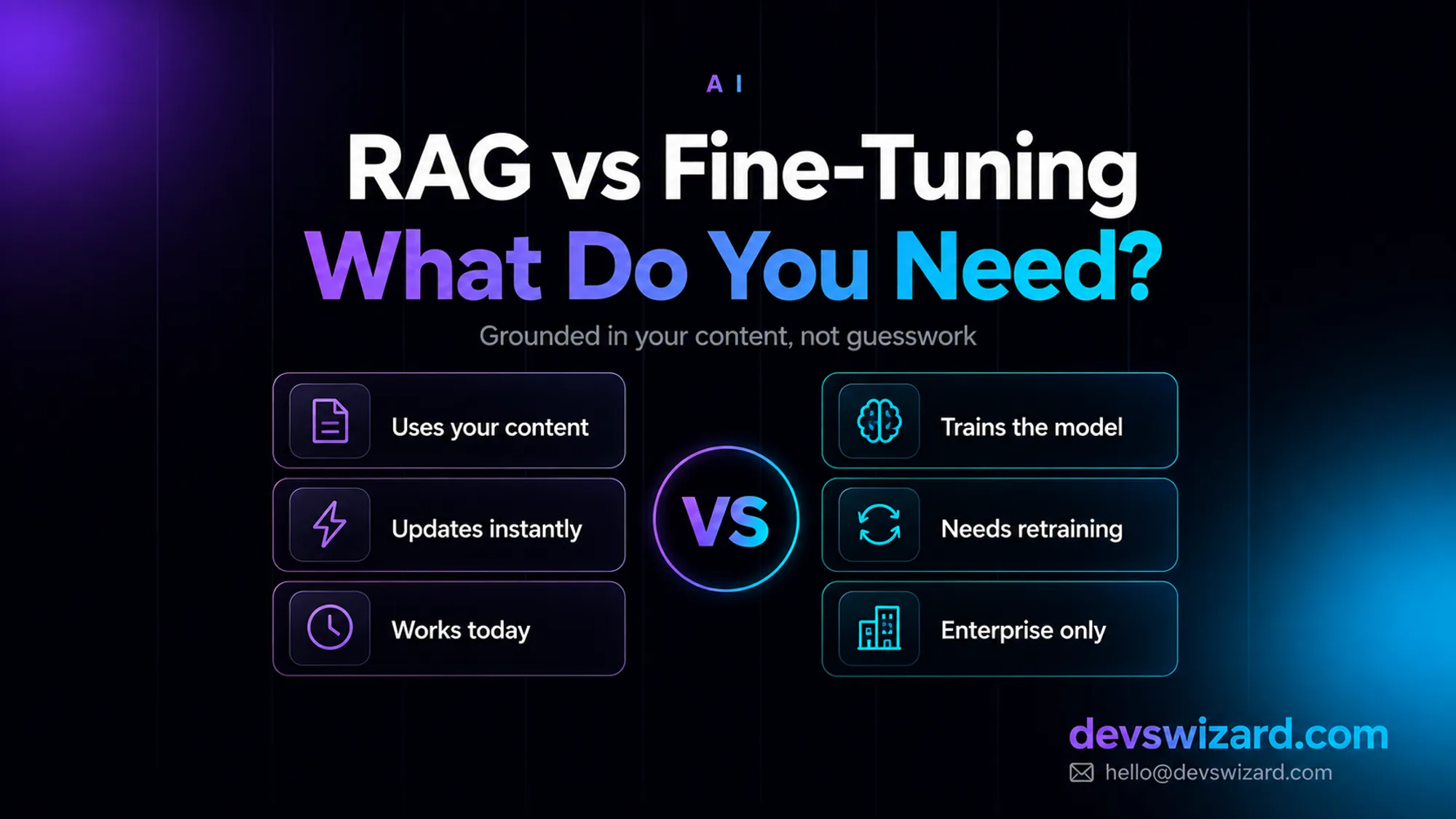
RAG answers from your content at query time for around $35–$70 a month; fine-tuning bakes knowledge into the model and isn't even offered as a self-serve option on Claude. What your business actually needs, and why it's usually not what you'd guess.
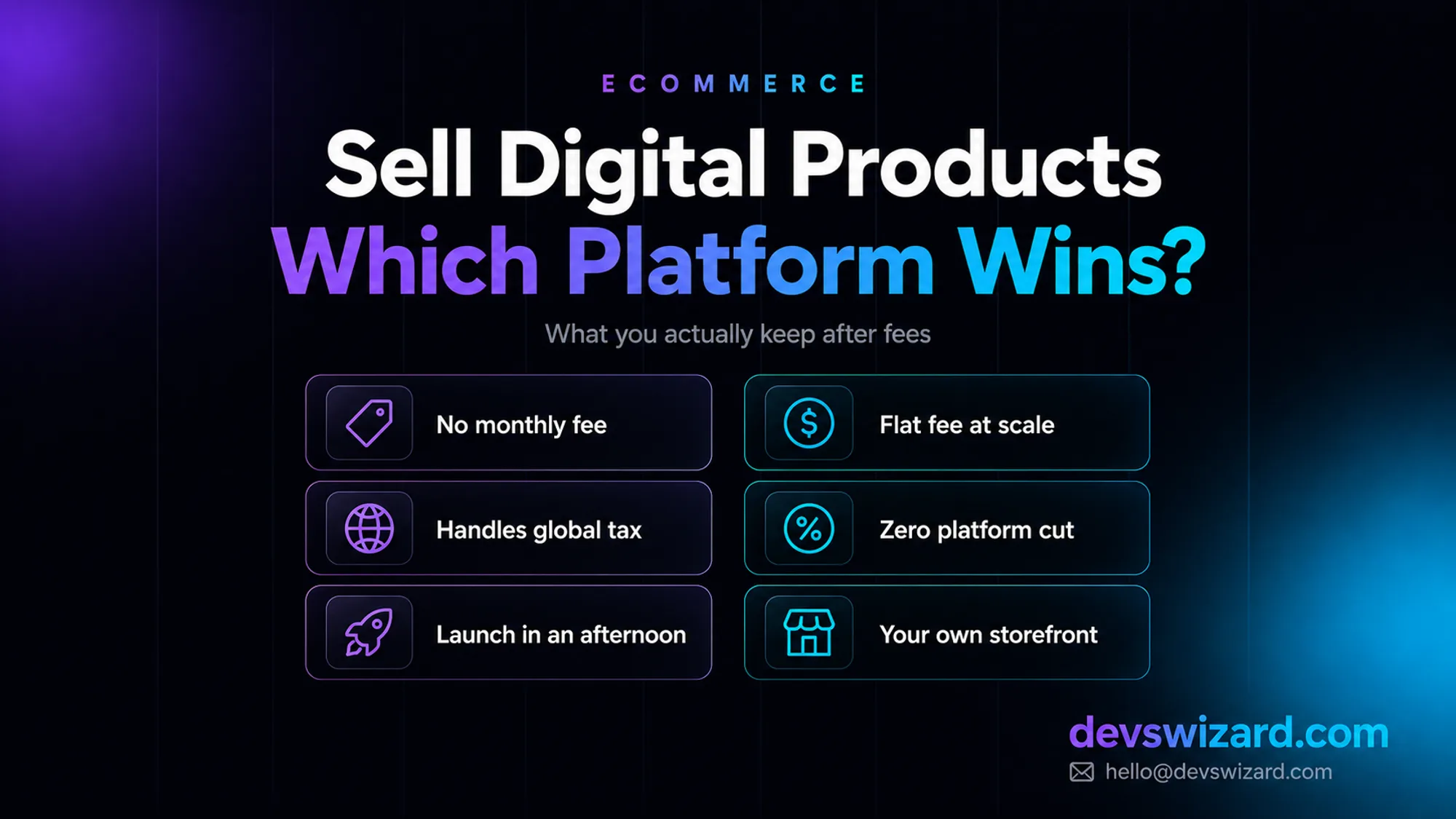
Gumroad takes 10% and Lemon Squeezy roughly 5%, both with no monthly fee; Sellfy and Podia flip that to a $29–$150 monthly charge with 0% cut. What you actually keep on a $79 sale, once a month and at $5,000 a month, decides which one is worth it.
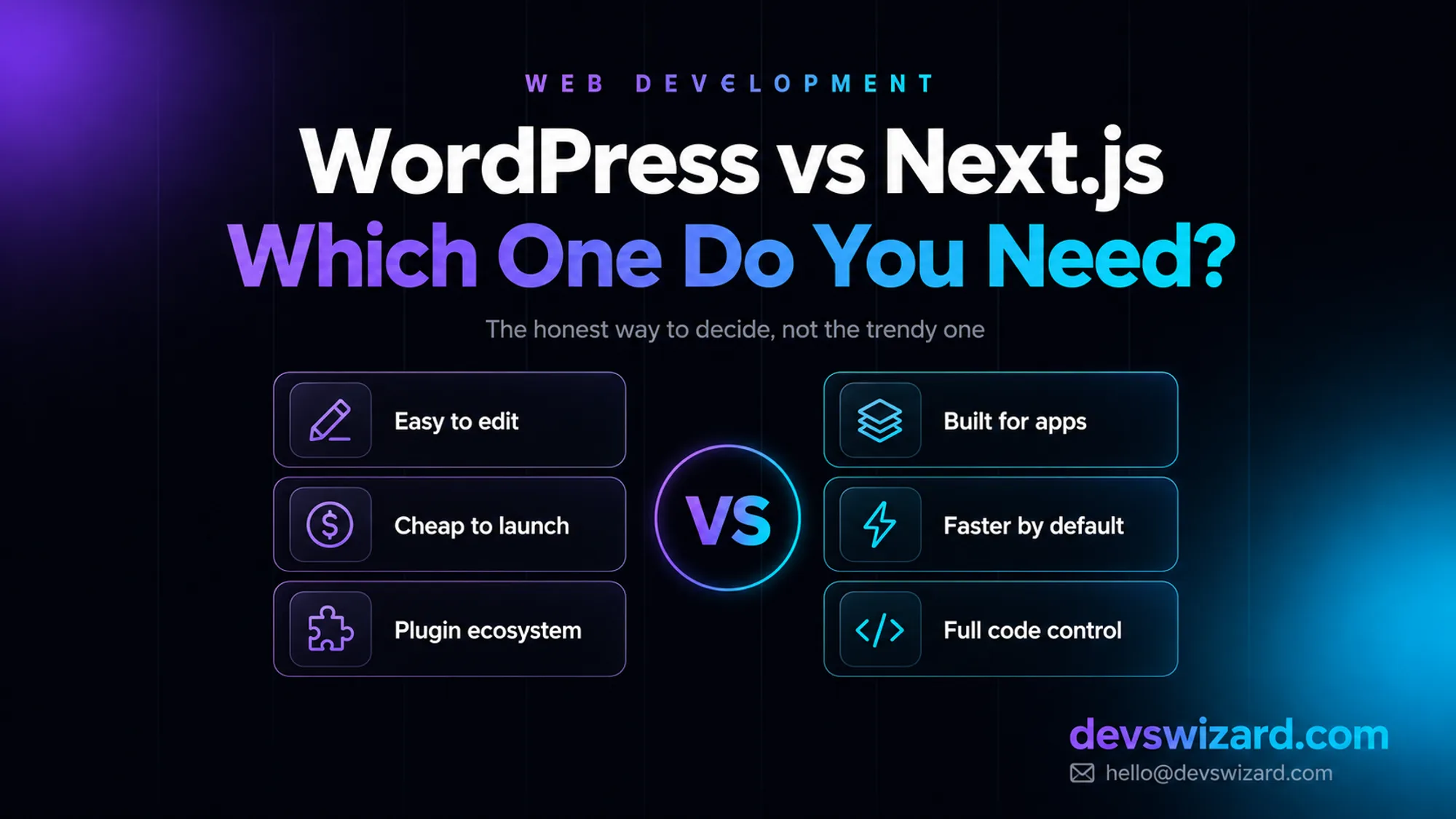
A gym owner asked for a Next.js site because it looked modern on Twitter. What he actually needed was a $500–$7,500 WordPress site for the marketing pages, plus one thing WordPress could never do well.