

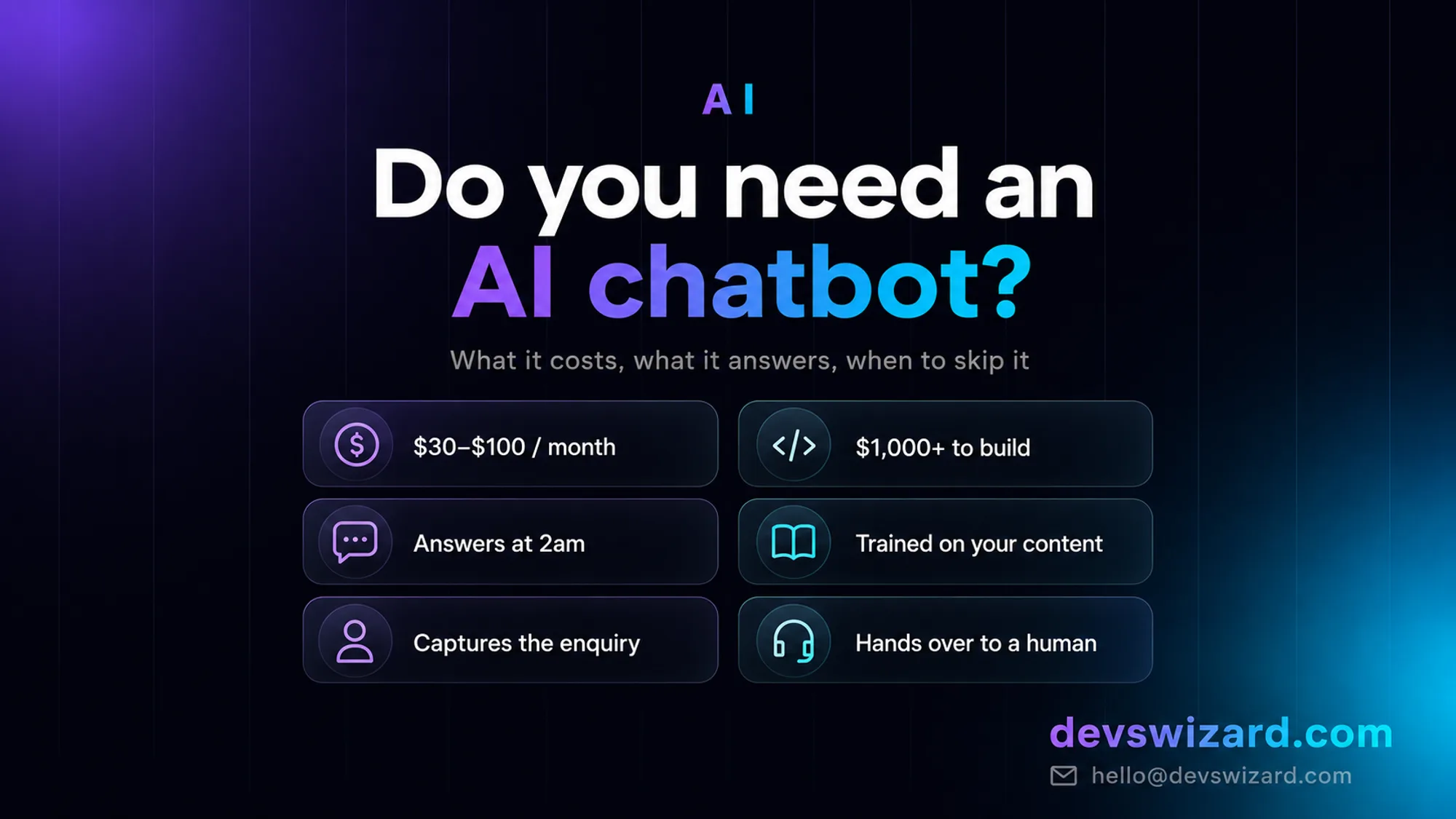
Every tool you already pay for has grown an AI chatbot, and every one of them is now emailing you about it. The pitch is always the same: answer customers day and night, capture leads while you sleep, cut support work. What nobody puts in the email is the price, or the part where it confidently tells a customer something untrue.
The short answer on cost: a hosted chatbot widget runs roughly $30–$100 a month at small-business volumes, or around $1 per conversation it resolves on the per-resolution plans. One built on your own content and installed on your own site costs $1,000–$3,000 once, then single-digit dollars a month to run. The build is the expensive part; running it is not.
The short answer on whether you need one: yes if the same ten questions arrive every week and the answers already exist in writing. No if your problem is that people are not visiting, or that nobody has written the answers down.
Strip away the marketing and it does one thing: it reads a body of text you supply — your service pages, prices, policies, delivery times — and answers questions using only that text. The useful ones are grounded, meaning they are told to answer from your material or admit they do not know.
That last one is worth the install on its own. A month of transcripts tells you which page is unclear, which price scares people, and what your site never answers.
Hosted widgets — the ones bolted onto helpdesk software. Roughly $30–$100 a month for a small business, and the AI part is often priced per resolved conversation at around $0.75–$1 each. Fine at 50 conversations a month, unpleasant at 2,000. These are list prices as of mid-2026 and they move; check before you sign.
A custom chatbot on your site — $1,000–$3,000 for a support bot grounded in your own content, and $3,000–$7,000 when it sits inside your product with several data sources and an admin panel to control it. Three to eight weeks, most of which is not AI work.
Running cost — the part people brace for and should not. A short, capped reply on a current low-cost model costs a fraction of a penny; a few hundred conversations a month costs single-digit dollars. We estimate it before building and set hard limits so it cannot surprise anyone.
| Factor | Hosted widget | Built on your content |
|---|---|---|
| Upfront | None | $1,000–$3,000 |
| Monthly | $30–$100, or ~$1 per resolution | Usually under $20 in model costs |
| Answers from | Your uploaded content, their rules | Exactly the text you approve |
| Wrong answers | Their guardrails, your problem | Tuned until it stops |
| Your data | On their servers | Your database |
| Change provider | Rebuild it there | Swap a key |
| Time to live | An afternoon | 3–8 weeks |
If you want it live this week and volume is low, take the widget. If it is going to answer thousands of people or represent your prices, own it.
Four terms show up in every AI quote, and the price gap between them is worth ten minutes of your attention.
Stuffed context is the simple one: your whole knowledge base is sent with every question. Cheap, easy to audit, and it works up to a few thousand words — a service list, prices, policies, delivery rules.
RAG — retrieval-augmented generation — searches your documents first and sends only the passages that match the question. You want it when the material is too big to send every time (hundreds of pages, a product catalogue, years of manuals), when it changes weekly, or when answers must cite the document they came from. It costs more to build and adds a little per question.
Embeddings and a vector database are the plumbing under RAG: your text becomes numbers that capture meaning, so a customer asking "can I send it back" finds the returns policy without using the word "returns". Keyword search misses that.
Fine-tuning teaches a model your tone and format, not your facts. People buy it expecting knowledge and get style. For a support chatbot it is almost never the right first spend.
Ask whoever is quoting you which of these they are building, and why. If the answer is fine-tuning for a support bot, ask again.
It cannot answer what has never been written down. The real work in every chatbot project is assembling the material — prices, policies, edge cases, what staff know and nobody has typed. That is where the weeks go, and why quotes that skip it come back higher later.
It will not rescue a site nobody visits. A chatbot converts traffic you already have; it does not create any.
And it will invent things if you let it. A bot told to be helpful with no grounding and no limits will make up a delivery time to be agreeable. Ours is told in writing never to state a price or timeline absent from its source text, and to say so when it does not know. That instruction is the difference between a useful bot and a liability.
The widget in the corner of this page is ours, and it is deliberately narrow.
It answers from a single knowledge file that mirrors our service pages, so there is one place to update when a price changes. No vector database, no retrieval step — the whole file goes with every question, which at this size is cheaper than RAG and easier to check. When the file outgrows the model's window we will move it to retrieval; today that would be machinery for its own sake.
It is capped at about 80 words a reply, because nobody reads a wall of text from a robot. It refuses anything outside our services and offers to take the person's details instead. When someone describes a project properly, it stops selling and opens the enquiry form.
The limits matter as much as the answers: five conversations per visitor per day, fifty messages per conversation, a few seconds between messages. Those caps exist so that a bored visitor or a bot cannot run up a bill. Every transcript lands in our admin, and we read them — several answers on our service pages exist because the chatbot kept getting the same question.
It is also provider-agnostic. The model behind it is a setting, not a rewrite: we can move between providers by changing a key, which is the same protection we build for clients. Nobody should be locked to one AI vendor's pricing in a market that reprices every quarter.
Same questions every week, answers already written → yes, and it will pay for itself in replies you stop typing.
Under 100 enquiries a month and you want it today → a hosted widget on the cheapest plan with AI replies.
It will quote prices, or handle customer data you would not put on a third-party server → build it on your own site.
Nobody has written the policies down → write those first. That document is the project; the chatbot is the easy half.
Traffic is the problem, not response time → skip the chatbot, fix the site. A faster, clearer site earns more than any widget, and keeping it that way is ongoing work either way.
We build these from $1,000, we tell you the monthly running cost before we start, and we will say when AI is the wrong tool for the job you described. If you have a shortlist of questions your customers keep asking, send it to us and you will get an honest read on whether a chatbot answers them.
Only if it is allowed to. Grounded in your text, capped in length, and instructed to hand over when unsure, it stays inside what you gave it. Ungrounded bots invent things — that is a build decision, not bad luck.
Someone should read the transcripts weekly for the first month and correct what it gets wrong. After that, monthly is enough. AI needs correcting once it meets real users, and everyone underestimates that part.
Tell us what you are building. We reply within 24 hours — no sales team, no follow-up sequence.
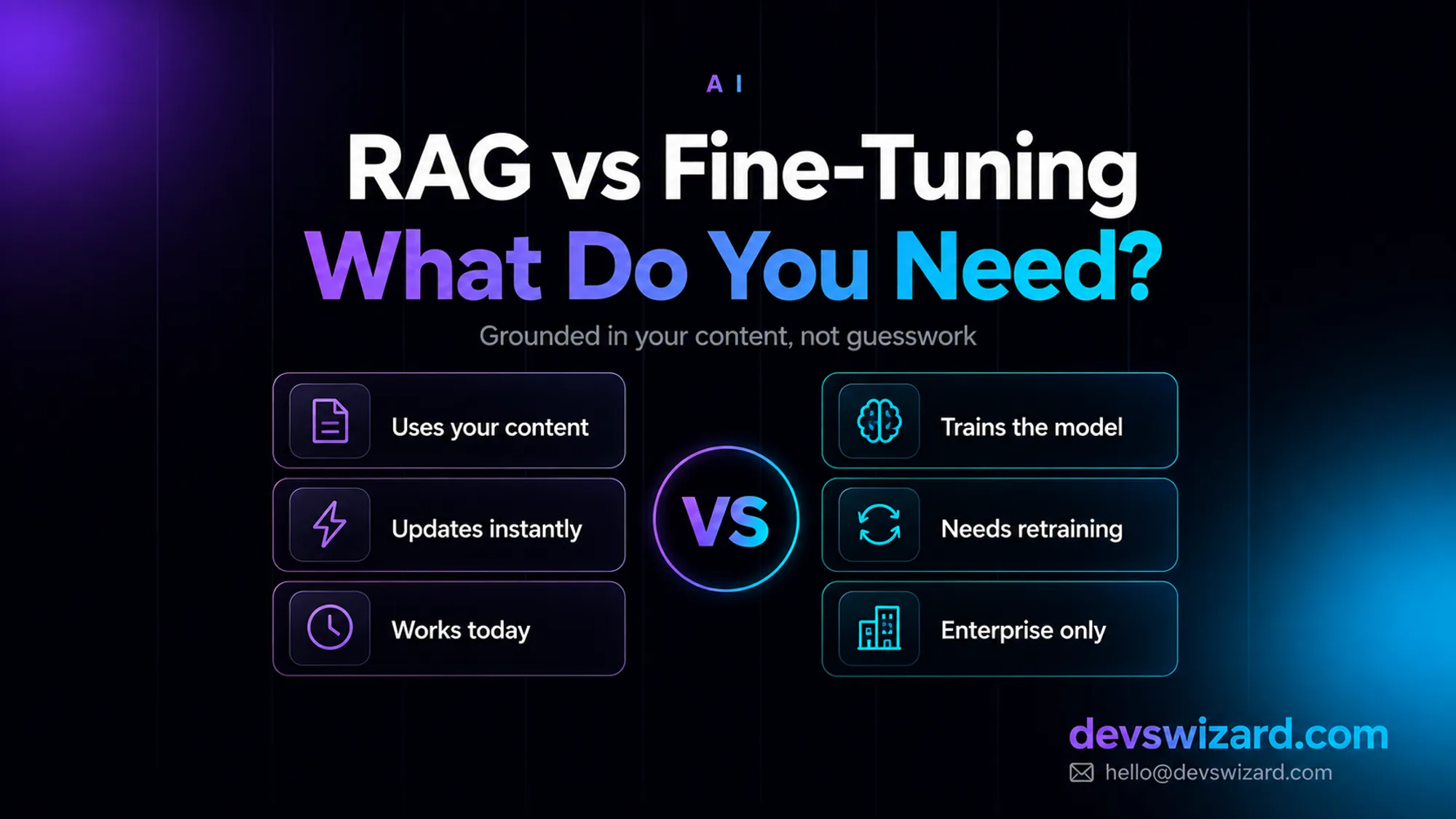
RAG answers from your content at query time for around $35–$70 a month; fine-tuning bakes knowledge into the model and isn't even offered as a self-serve option on Claude. What your business actually needs, and why it's usually not what you'd guess.
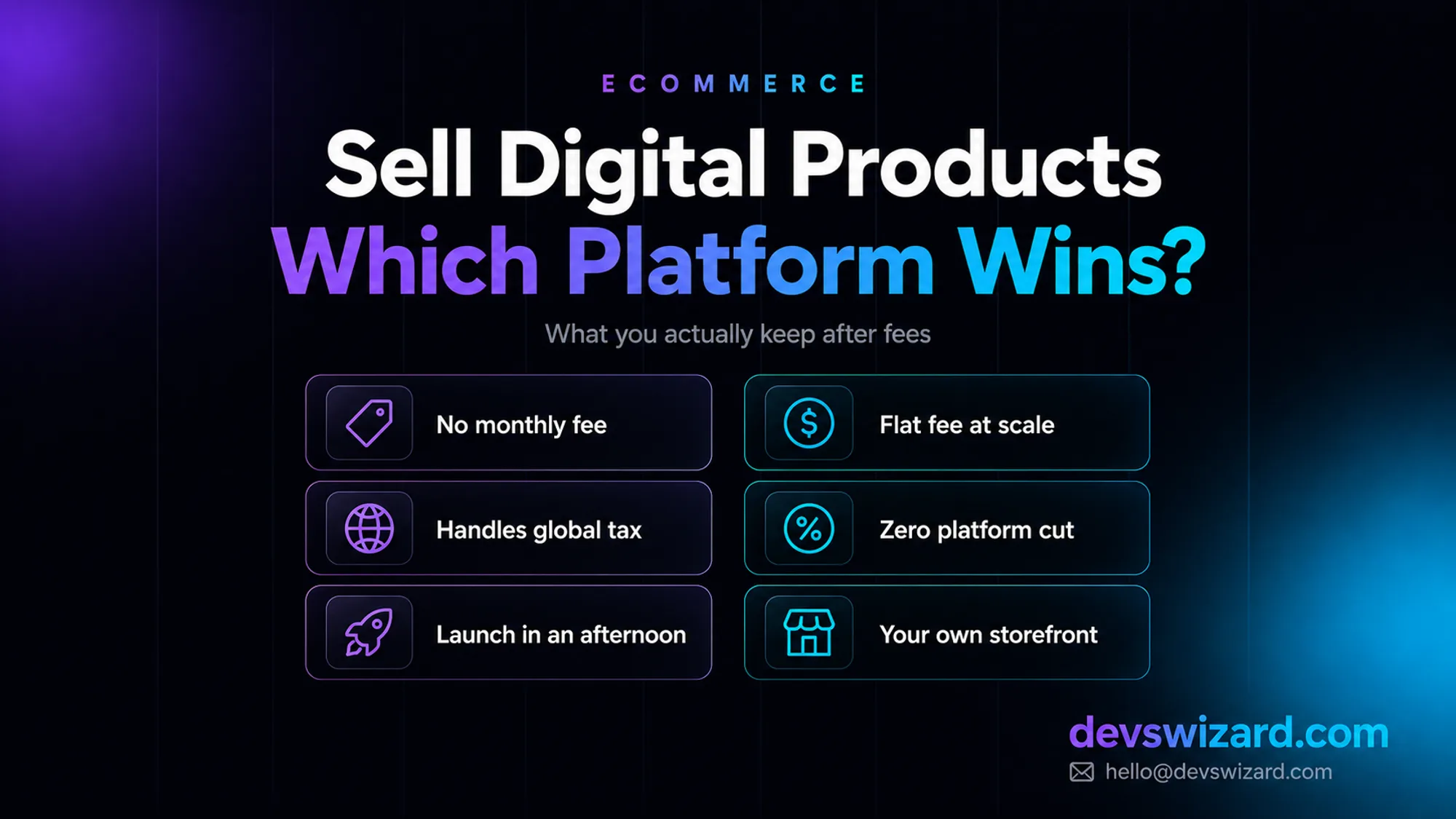
Gumroad takes 10% and Lemon Squeezy roughly 5%, both with no monthly fee; Sellfy and Podia flip that to a $29–$150 monthly charge with 0% cut. What you actually keep on a $79 sale, once a month and at $5,000 a month, decides which one is worth it.
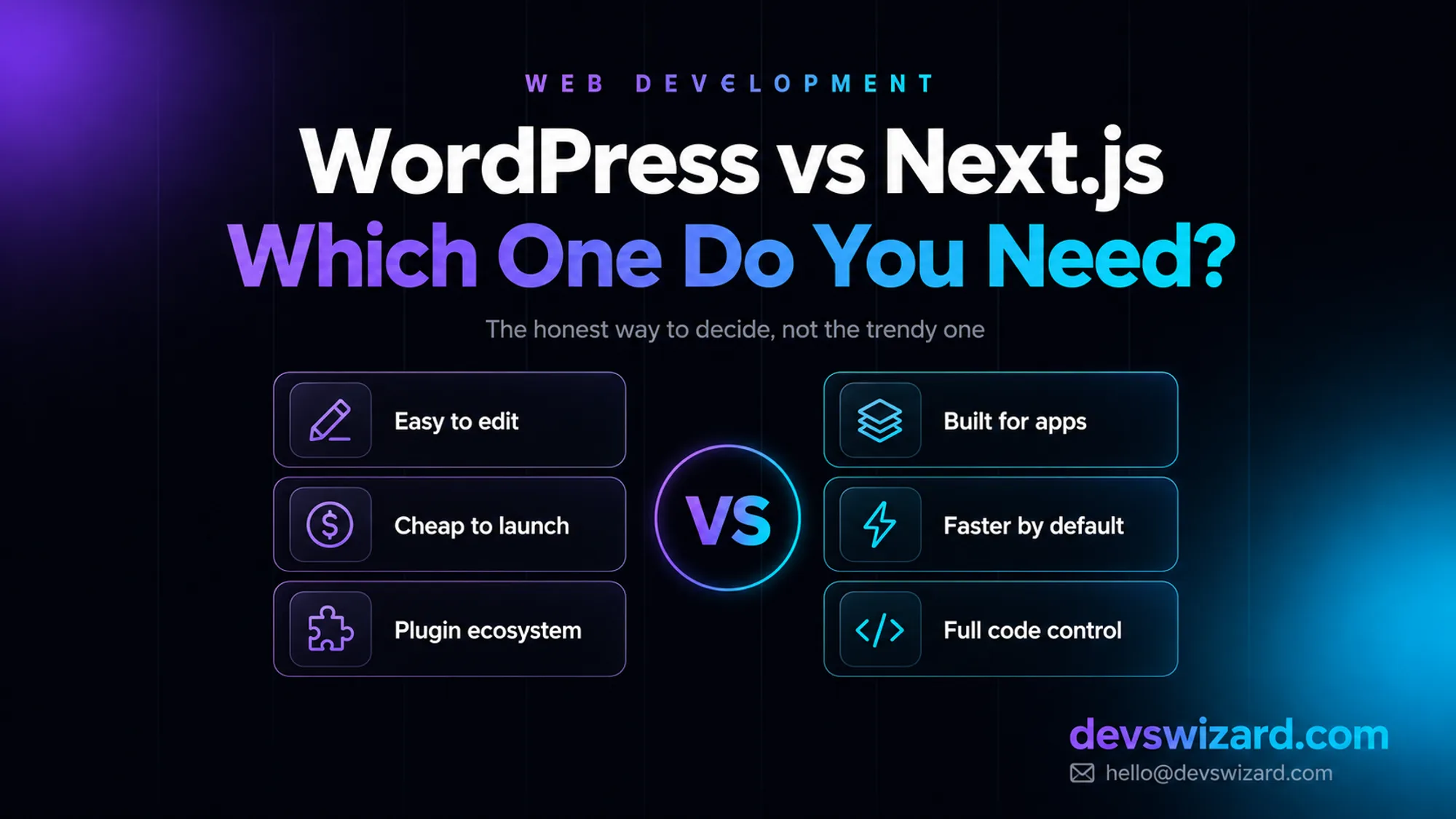
A gym owner asked for a Next.js site because it looked modern on Twitter. What he actually needed was a $500–$7,500 WordPress site for the marketing pages, plus one thing WordPress could never do well.